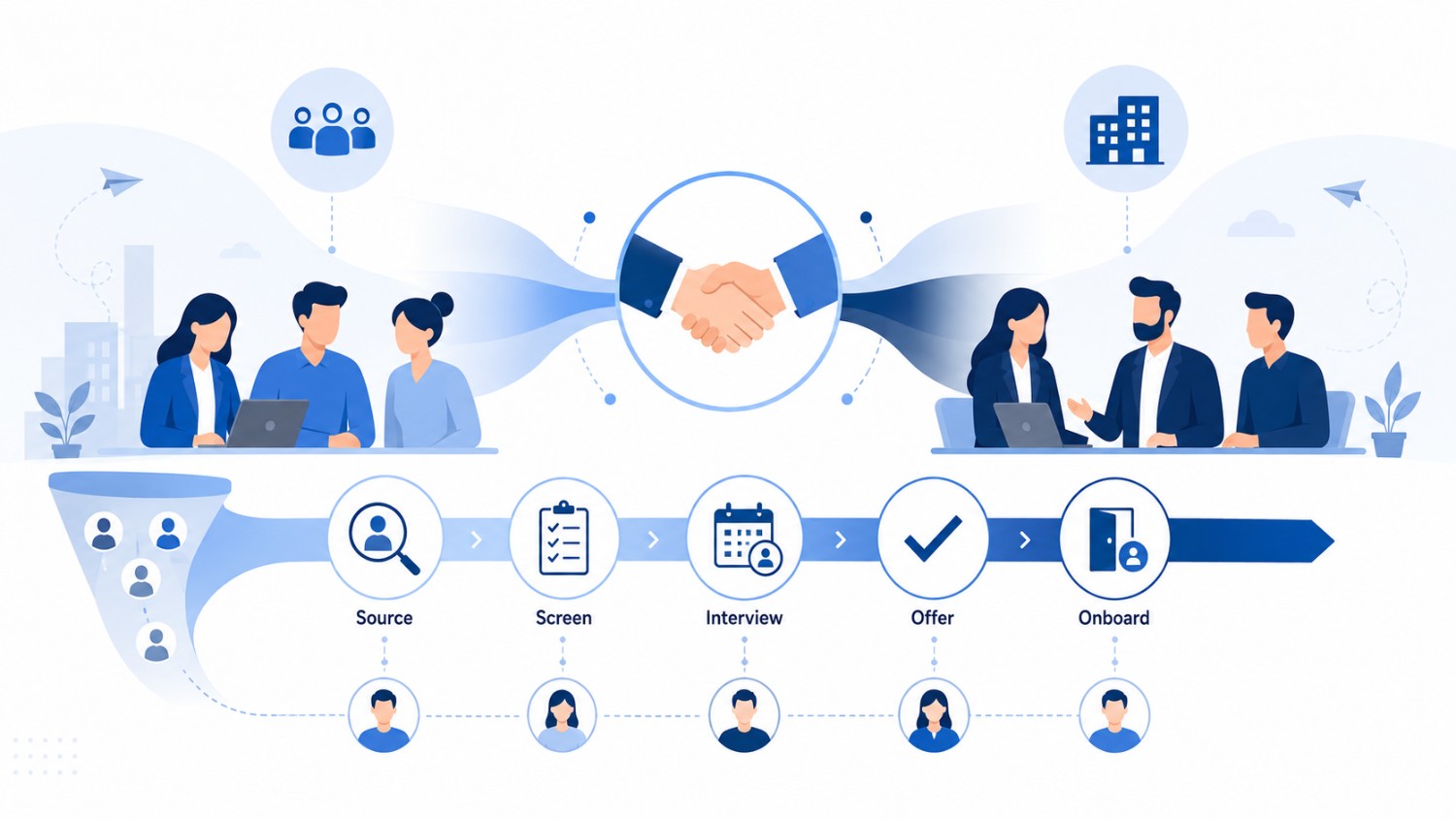
Recruitment process outsourcing, or RPO, is what people call it when a company brings in an outside provider to actually run its hiring — not just source candidates and hand them off, but own the whole thing from figuring out who’s needed to getting them through the door. That’s really the piece people miss when they first hear the term: a staffing agency finds you people; an RPO provider runs the process itself.
If your hiring process feels like it’s eating more hours than it should, you’ve probably run into the term somewhere along the way. Most people hear “RPO” and assume it’s just outsourced recruiting, full stop — but the ownership piece is what actually separates it from everything else in the hiring-help category, and that distinction matters more than it sounds like it should once you’re the one signing the contract.
How Does RPO Actually Work?
Once you actually bring a provider in, here’s roughly what happens — though the order and detail shift a bit depending on who you’re working with:
- Figuring out what the business actually needs and building a plan around it
- Writing or fixing up job descriptions
- Finding candidates
- Screening them down to a shortlist
- Running interviews and assessments
- Handling the offer
- Getting new hires onboarded
- Reporting back on how it all went
It’s not a set-it-and-forget-it handoff, either. A provider worth paying stays in close contact with your internal team the whole way through, because hiring needs rarely stay still for long.
Why Do Companies Turn to RPO?
Nobody outsources recruitment for the fun of it. It’s usually because something’s already broken. Cost per hire has crept up. Time to hire has stretched past what leadership will tolerate. Or the internal team is stretched thin and doesn’t have the tools a specialist provider already has sitting there.
Korn Ferry has published figures showing clients cutting cost per hire by around 30% and time to hire by roughly 35% after moving to RPO, alongside better candidate experience scores. I’d take any single vendor’s numbers with a grain of salt, but the direction lines up with what shows up across the industry more broadly.
What Are the Different Types of RPO?
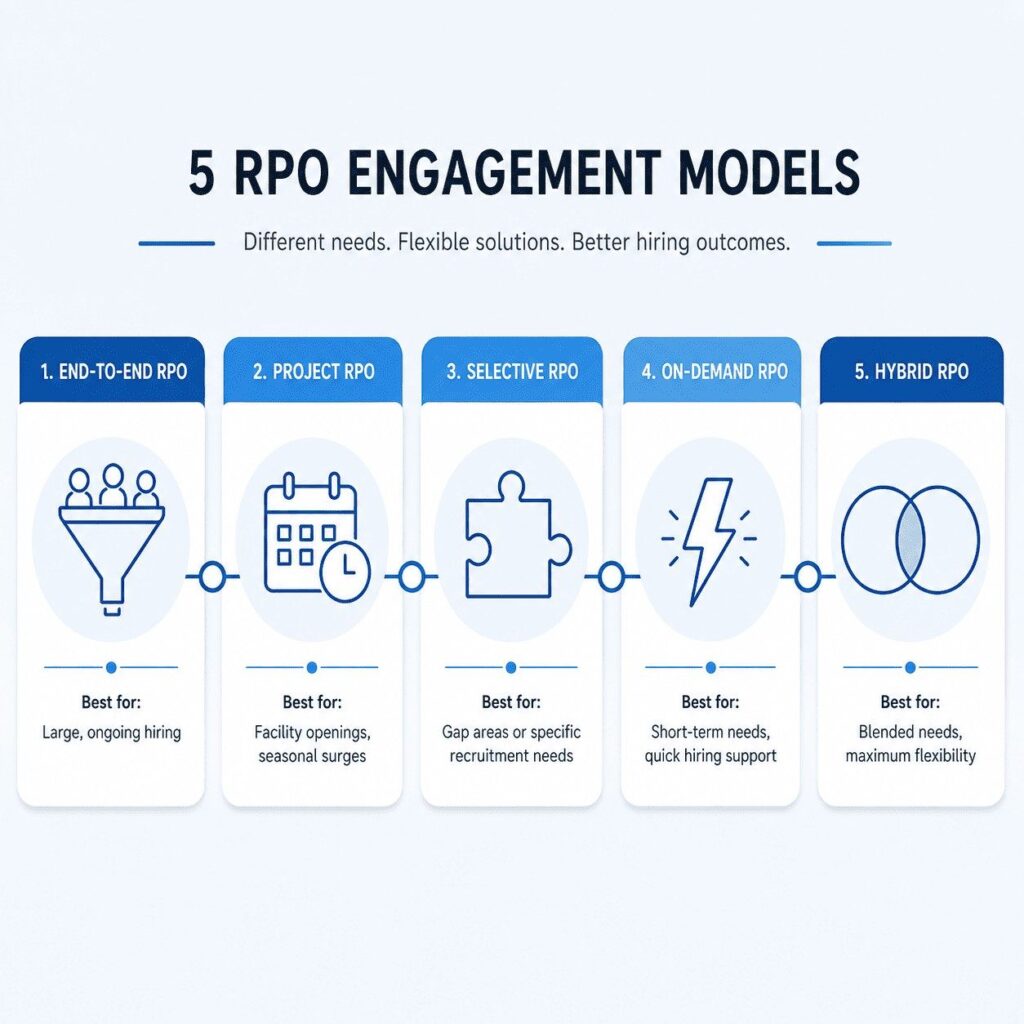
Picking the wrong model is probably the single most common mistake I see people make with RPO. It really comes down to matching the engagement to what you actually need:
- End-to-End RPO — best for large, ongoing hiring. The provider runs the whole recruitment function, not just a piece of it.
- Project RPO — best for facility openings and seasonal surges. Built for a defined window, then it wraps up.
- Selective RPO — best for gap areas or specific recruitment needs. You keep most of your internal team and hand off just the piece that’s struggling.
- On-Demand RPO — best for short-term needs and quick hiring support. No long contract, just extra hands when you need them.
- Hybrid RPO — best for blended needs and maximum flexibility. Internal and external recruiters working side by side.
RPO vs Recruitment Agency vs MSP vs In-House Hiring
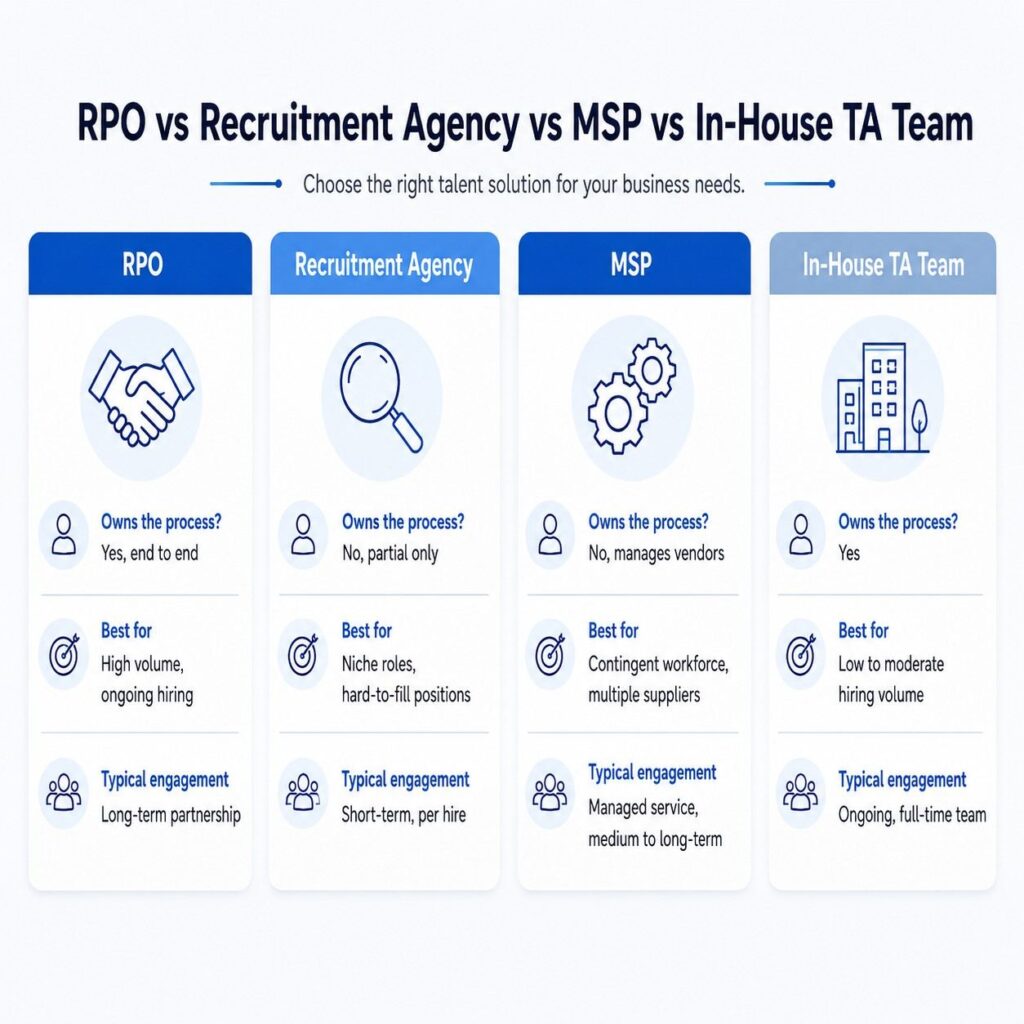
People mix these four up constantly, and honestly, the confusion usually comes down to one question: who actually owns the process?
- RPO — owns the process end to end. Best for high volume, ongoing hiring, run as a long-term partnership.
- Recruitment Agency — doesn’t own the process, only partial involvement. Best for niche roles and hard-to-fill positions, engaged short-term on a per-hire basis.
- MSP — doesn’t own the process either, it manages vendors. Best for contingent workforce needs across multiple suppliers, typically a medium-to-long-term managed service.
- In-House TA Team — owns the process fully. Best for low to moderate hiring volume, run as an ongoing, full-time internal team.
What Does RPO Look Like in Practice?
Picture a manufacturer opening a new plant that needs 300 people hired within six months. Building a permanent internal team for that would be a waste once the hiring wave is over, so Project RPO is the obvious fit. A startup with zero internal recruiters, on the other hand, is probably better off with end-to-end RPO from day one. And a company with a decent internal team that’s simply drowning in sourcing work might only need help with that one piece.
When RPO Isn’t the Right Call
This is the part most articles on this topic skip, probably because it doesn’t help them sell anything. RPO isn’t for everyone. If you’re only filling one or two specialist roles a year, an agency will likely get it done faster and cheaper. If your internal team is already performing well, adding an outside partner just adds a layer of coordination you didn’t need. Short-term, small-scale hiring usually doesn’t justify it either — and if your organization isn’t ready to let an outsider into your process, that resistance will show up in the results no matter how good the provider is.
How to Choose an RPO Provider
A few things are worth checking before you sign anything. Does the provider actually specialize in your industry, or are they generalists? What does their reporting look like — can you see what’s happening, or do you just get updates when they feel like sending them? How flexible is the engagement if your needs change mid-contract? And are the pricing and SLAs actually spelled out, or vague enough that you’ll be arguing about them in month four?
Common Questions About RPO
What does RPO stand for?
Recruitment process outsourcing — hiring part or all of your recruitment function out to a specialist provider.
Is RPO the same as a staffing agency?
No, and this is the mix-up that trips people up most. A staffing agency fills individual roles as they come up. An RPO provider owns the ongoing process — strategy, sourcing, reporting, the whole thing.
How much does RPO cost?
It usually comes down to a per-hire fee, a flat retainer, or some blend of the two. Ask any provider to walk you through their actual model before assuming either one fits your situation.
Can small businesses use RPO?
Depends entirely on volume. Hiring a handful of people a year? A staffing agency is probably cheaper and simpler. Once hiring picks up enough to justify an ongoing partnership, that’s usually when RPO starts making sense.
How long does an RPO engagement usually last?
Varies by model — Project RPO might run a few months to cover one hiring push, while end-to-end RPO tends to be an ongoing, multi-year relationship.
Key Takeaways
If you only remember one thing from this, make it the ownership distinction — everything else follows from that. RPO providers run your recruitment process; agencies and MSPs just fill a specific gap in it. Beyond that:
- The right model comes down to volume and timeline, not preference — a one-time hiring surge and an ongoing talent function need completely different setups
- It’s genuinely not the right move for low-volume or highly specialist hiring, where an agency will usually be faster and cheaper anyway
- Pricing structures vary enough between providers that it’s worth asking directly rather than assuming
There’s no universal answer to whether RPO makes sense for your business. It depends on where the hiring process is actually breaking down, not on what’s trending in HR circles this year. If you’re trying to work that out, Human Asset’s recruitment process outsourcing services are worth a conversation — the approach gets built around your specific gap, not the other way around.
Howdy folks! I decided to give mluvabetcasino a try. The selection of payment methods is good, and I appreciate the quick customer service. Definitely a decent choice for online gaming. mluvabetcasino
Use our Salary Calculator to convert hourly wages into annual, monthly, weekly, and other income amounts. Include overtime and work hours to get a clearer estimate of your total earnings.
Salary Calculator
Check out this resource: AI交易解决方案 – 智能市场自动化平台