

Executive search firms exist for one reason: some hires are too risky to leave to a normal job posting. Think C-suite roles, or anyone whose exit needs to stay quiet until it’s announced. These firms don’t sit around waiting for applications. They go find the person, usually while that person is still happily employed somewhere else. It goes and finds people who already have a job and weren’t planning to leave it.
That’s the whole game, honestly. Everything else is detailed.
Executive Search vs. Traditional Recruitment
People throw these two terms around like they mean the same thing. They don’t, and you’ll feel it in your budget if you assume otherwise.
Recruitment agencies cast a wide net across all kinds of roles. Executive search firms narrow in on leadership and specialized positions almost exclusively. Recruiters mostly talk to people who are actively job hunting. Executive search firms go after people who aren’t, which is a different job entirely — you’re persuading, not filtering. Payment structures differ too: recruitment is usually success-based, you pay when someone’s hired. Executive search is typically retained, so the firm gets paid to run the search regardless of the exact outcome date. And the vetting goes deeper on the executive side. More research, more direct conversations, more assessment before a client ever sees a name.
What Actually Makes a Search “Executive”?
Not the job title. That’s the part people get wrong.
A first-time hire for a role like Chief AI Officer counts as executive search even though the title barely existed five years ago, because almost nobody has done the job before and finding someone who can is genuinely hard. Meanwhile, hiring a tenth regional sales manager off the usual playbook doesn’t, even if “manager” sounds senior on paper. What makes something executive-level is the difficulty of the search and how much is riding on getting it right — not what’s printed on the offer letter.
Types of Executive Search: Retained, Contingency, Specialist, Generalist
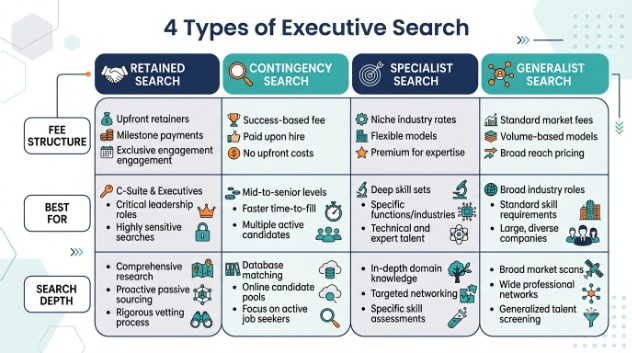
These aren’t interchangeable, and picking the wrong one wastes both time and money.
Retained is what most firms run for genuinely senior roles — paid upfront, deep research, one firm working the search exclusively. Contingency looks more like standard recruiting: faster, cheaper, and shallower, paid only if someone gets placed. Specialist firms live inside one industry or function and know it cold. Generalist firms cover more ground but won’t go as deep in any single area.
How the Executive Search Process Works
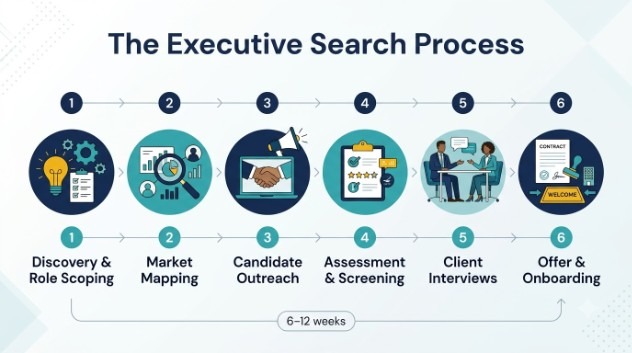
Six to twelve weeks isn’t a random number. Here’s where the time actually goes.
It starts with actually understanding the role, not the job description someone typed up in ten minutes. From there:
- Discovery & role scoping — getting past the job description to what the business actually needs
- Market mapping — figuring out who’s genuinely out there and qualified
- Candidate outreach — quietly reaching people who fit, most of whom aren’t job hunting
- Assessment & screening — real vetting, not a resume-against-checklist exercise
- Client interviews — only the handful worth the client’s time make it this far
- Offer & onboarding — the firm usually stays involved here too, since a lot can still fall apart at this stage
Most searches run six to twelve weeks. Specialized or niche roles regularly blow past that. Nobody likes hearing the number can move, but it does.
Why Companies Use Executive Search Firms
Because the cost of getting a leadership hire wrong is brutal, and most companies have felt that at least once.
- You reach passive candidates who aren’t visible any other way
- Confidentiality matters when you’re replacing someone still in the seat
- Cultural and leadership fit gets assessed properly, not guessed at
- The overall risk on an expensive hire goes down
Is Hiring an Executive Search Firm Actually Worth It?
Sometimes no, and it’s worth just saying that instead of dodging it.
If the role is business-critical, hard to fill, or needs to stay quiet, an executive search firm usually earns its fee. If you’re hiring in volume, filling junior roles, or working with a tight budget, it’s probably overkill — you’re paying for depth and discretion you don’t actually need there. The value only shows up when the search itself is genuinely hard.
Executive Search in India
India’s leadership hiring market isn’t one thing. It shifts sharply depending on which city and which sector you’re looking at, and treating it as uniform is where a lot of searches go wrong before they even start.
Mumbai’s demand sits heavily in BFSI and financial services, sectors where confidentiality often matters more than speed, since a lot of these searches involve replacing someone who’s still actively in the role. Our page on executive search firms in Mumbai covers how that plays out in practice.
Bangalore runs a different kind of search entirely. Tech and GCC leadership hiring dominates there, and the pool of genuinely qualified people is small enough that multiple companies are often chasing the same names at the same time. We go into more detail on that in our guide to executive search firms in Bangalore.
Beyond these two, hiring patterns vary just as much across Delhi, Pune, and other hubs, each shaped by their own dominant industries. For the broader national picture, our guide to executive search firms in India walks through it.
FAQs
What’s the difference between executive search and headhunting?
Not much, in practice. “Headhunting” is often just informal shorthand for executive search, though some people reserve it specifically for a direct, targeted approach to one named person.
How long does executive search take?
Usually six to twelve weeks. Highly specialized or senior roles can take longer.
Do executive search firms only hire for C-suite roles?
No. They take on any role that’s strategically important or genuinely hard to fill, which can include specialized roles well below the C-suite.
What is retained executive search?
A model where the client pays the firm upfront to run the search, rather than paying only when someone gets placed. It usually comes with deeper research and exclusivity than contingency search does.
How much does an executive search firm charge?
Usually 25-33% of the role’s first-year total comp, paid out in stages as the search moves along. Not cheap, but that’s kind of the point — you’re not paying for this unless the hire matters enough to justify it.
Can a company run executive search in-house instead of hiring a firm?
Some do. Big companies with their own senior talent teams pull it off fine. Most don’t have the market reach or the spare time, though, which is basically why firms like this exist in the first place.
What industries use executive search the most?
BFSI, tech, healthcare, manufacturing — these show up constantly, mostly because a leadership gap in any of them gets expensive fast. But really, any industry ends up here eventually once a role gets senior or specialized enough.